
Fresh & Local
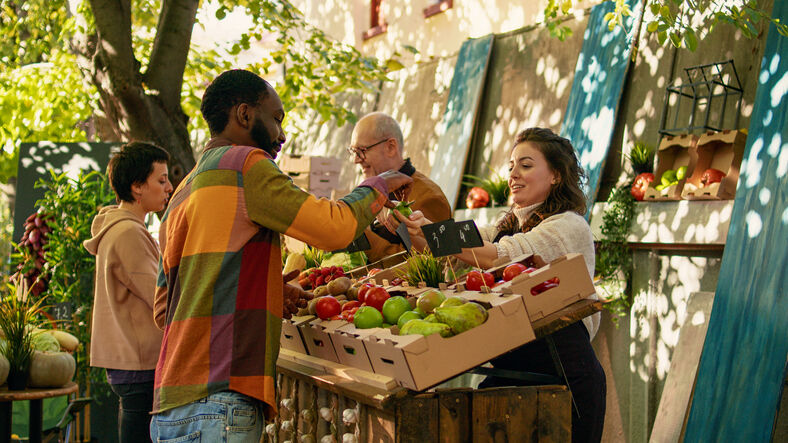
Today, with many consumers’ desires to patronize local farmers and vendors and purchase farm-to-table produce, farmers markets are booming.
An estimated 8,720 farmers market were held in the United States in 2022, and generated approximately $1 billion, according to the Agricultural Marketing Resource Center. The benefits to shopping at a farmers market are plentiful and include the desire to eat healthier, stimulate local economies, and preserve rural livelihoods and farmland.
Markets provide one of the only low-barrier entry points for beginning farmers. This allows them to start small and test the market while learning how to grow their businesses.
American Farmland Trust, a nonprofit organization based in Washington, D.C., and dedicated to protecting farmland, reports that small and mid-size farmers who sell at markets have nearly a 10 percent greater chance of staying in business than those selling goods through traditional channels.
In today’s challenging agribusiness environment, farmers markets provide small, beginner and seasoned farmers alike the opportunity to launch new enterprises.
Farmers markets have a great appeal to the health conscious as they provide greater access to fresh, fresh fruits and vegetables, and many of them offer gluten-free foods.
Goods at farmers markets are typically sold during their peak growing season, meaning they are likely at their freshest and tastiest. On average, food sold at grocery stores travels more than 1,000 miles from the point of production to the point of sale. That is a stark contrast from farmers markets, which often offer food grown within a 50-mile radius.
The Farmers Market Coalition (farmersmarketcoalition.org) notes proximity to farmers markets is associated with lower body mass index (BMI) among youths, while the density of fast-food and pizza venues was associated with higher BMI. A 12-week study conducted in Austin, Texas, found that the placement of farmers markets outside low-income communities increased consumption of fruits and vegetables among people within walking distance.
Farmers markets have also been proven to return more than three times as much of their revenue to the local economy compared to chain competitors, according to the Farmers Market Coalition. This “economic multiplier effect,” as it is known, helps create jobs and boost local economies.
One other great benefit to shopping at a farmers market is the education factor. Have you ever met a farmer who didn’t love to share a secret or two? If you are looking for tips on how to prepare fresh offerings or to spice up that tomato salsa, just ask a vendor. They will more than likely provide a new recipe.