
Avoid information overload
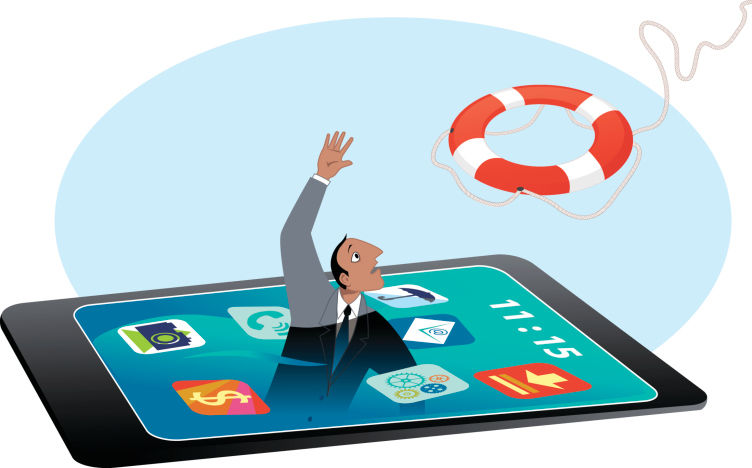
When tests at the doctor’s office didn’t give Shannon Garcia a good explanation for her stomach troubles, she was frustrated.
So, the 34-year-old Romeoville, Ill., woman did what plenty of us have done when we get an ache or pain we can’t quite figure out: She logged onto Facebook, and vented to her online friends.
Responses flooded in from well-meaning pals. Had she tried changing her diet? Could it be a problem with gluten? Garcia thought maybe they were right.
But then when she started searching the Web, Garcia became even more confused. There was no simple explanation of gluten intolerance and stomach issues. Not even a couple. Instead, she found herself in an Internet wormhole, clicking from site to site, quickly overwhelmed. She was even more confused about what might be going on with her digestive system.
“I still really don’t know what to believe,” she says. “I almost was like, ‘Maybe I should go to school for this.’”
As we find ourselves with more ways to get more information—and more ways to discuss our health with other people—situations like Garcia’s are becoming increasingly common.
Not so long ago, most of us would have gone straight to the doctor’s office if we had a sore throat or a weird stomach pain. If we wanted to figure out how to shed some pounds, we might have bought a book or signed up for help from a nutritionist or personal trainer.
And while most of us still make those appointments eventually, we’re often doing something else first: consulting health websites, posting on message boards or consulting our Facebook friends.
Though this overflow of information can confuse us with conflicting data and advice, it’s not always a bad thing.
Dr. Brian Burkey is director of the Cleveland Clinic’s Center for Consumer Health Information. He says most of his patients have done a fair amount of their own research before their first appointment, and it can often be an enlightening experience.
“I recently saw a patient with thyroid cancer, and I think he had checked every website known to man,” Burkey says.
A study of more than 1,600 cancer patients by researchers at the University of Pennsylvania’s Annenberg School for Communication found that people turned to a wide variety of sources outside their doctor’s office to learn more about their health.
Nearly half of the people surveyed said they’d consulted friends and family, while more than 34% scoured the Web for help. Plus, there were books, magazines, newspaper articles and television shows, among plenty of other ways to get more information.
In the big picture, experts say having more information at our fingertips can be a good thing. It means people from all walks of life can take more ownership of their own health, and find a wealth of useful facts, tips and techniques that can boost their well-being.
Cutting through the clutter
It can be daunting to make heads or tails of the feedback you get from searches, online chats and Facebook posts. Toby Smithson, a Chicago-area diabetes educator and nutrition counselor, says pulling what you need out of all of that chatter can be a struggle.
“In a sense, it’s a bottomless pit,” she says. “There’s so much information and clutter. There’s so much that we’re overwhelmed and over-stimulated.”
But all your searching isn’t for naught. In that pit are plenty of facts and tips that could provide a big help. Smithson says the key for anyone who starts digging more information is to keep one thing in mind: All information is not created equal.
Smithson spells it out to her clients in three steps.
First, do your best to make sure the information you’re gathering comes from a reputable source. Well-known, national organizations are typically a good place to start. For diet tips, that means the Academy of Nutrition and Dietetics. For heart health, the American Heart Association; for diabetes, the American Diabetes Association.
“These are national, reputable organizations that use only science-based information,” Smithson says.
Burkey suggests looking for related articles and checking your symptoms on the Mayo Clinic and the Cleveland Clinic websites.
“Both of our hospitals have quite a large staff who oversee (the websites),” he says. “They verify health information.”
If you’re more inclined to click on every link that pops up on Facebook or Twitter, slow down and look closely to figure out who and what, exactly, is the source of the information, Smithson says.
On websites like WebMD or Livestrong, articles often include source references or links to the original studies, Smithson says. It may take a little extra reading, but it can help you determine if that story about coffee boosting your health is actually backed up with solid research—or if it’s just someone’s caffeine dream.
“You want to see where it’s coming from, and what methods they use to do the testing,” Smithson says.
Finally, Smithson urges her clients to look for a second opinion—the kind you find in real conversations with real professionals. Still confused about why you might want to go gluten free? When you should buy organic? How many meals should I eat each day? Just ask.
Dr. Michael Cirigliano is an associate professor of medicine at the University of Pennsylvania’s Perelman School of Medicine, and he echoes Smithson’s sentiment.
He says to think about it like you’re doing your taxes. When you’re stumped, you ask an accountant or tax preparer for help. Why wouldn’t you do the same for your health?
“You need someone—a primary health care provider—to guide you through the shark-infested waters of health and health care, even more so now than in the past,” he says. “Not only is there more knowledge out there, but there’s all kinds of misinformation out there.”
Avoid the too-much-info panic
One quick search can launch a full-blown panic in no time flat—even if you’ve got reputable health sources, Cirigliano says. After they’ve done their homework and self-diagnosis, many people, including some of his patients, think a minor problem means something much worse.
One recent patient of Cirigliano’s came in with a condition called pulmonary hypertension—the blood pressure in his lungs was higher than normal. But the man, who had been doing his own research online, convinced himself it was a more serious situation, one that required lung surgery.
“This man was freaking out because he had himself diagnosed with needing a lung transplant,” Cirigliano says.
Remember that anything can be posted online, and many conditions share the same symptoms. So do research up to where you feel comfortable, but take everything with a grain of salt. It’s always better to consult a real doctor than to make your own guesses based on stuff you’ve read online. After all, they’re the ones with the training and medical degrees. It’s their job to know this stuff and help you, so let them.
And Burkey knows firsthand about people who self-diagnose, but then don’t listen to reason when their theories are proved wrong. He says people who deal with serious or long-term illnesses sometimes are often convinced they’ve found the answers, and don’t want to hear anything else.
“The only time I ever get frustrated is when people come in with what they think is the answer, and become argumentative,” he says.
At the same time, experts warn that people shouldn’t dismiss their concerns because a Facebook friend or two tells you that they don’t sound like a big deal. The person who thinks they’ve sorted out their problems and avoided a trip to the doctor may have made a mistake.
“There is a danger, a well-documented danger, that they may get misinformation,” Burkey says. “Anything on the Web is not going to be tailored to your specific issues and situation.”
Making something happen
With so much information at our fingertips, you’d think we’d all be getting healthier. Unfortunately, that’s not always the case. Even if we take the time to filter out the clutter and find relevant information, it’s meaningless until we actually put down our phones and tablets, turn off our computers, and do something.
Smithson points to a recent poll by Gallup, which showed that Americans’ eating habits got worse in 2013. The survey of 500 adults found that fewer people reported eating healthy all day than in 2012. In several months, the number of people reporting healthy eating was at its lowest point since 2008.
“I truly think we are so busy. That’s the issue,” Smithson says. “As much technology as we have and advancements we’ve made to do more with less, there’s a lot more stress on us, and we’re overwhelmed.”
Burkey says the ever-growing list of places to seek information and advice is particularly helpful to a certain type of person: one who is already assertive about taking care of himself or herself. For people who might be dragging their feet on healthy habits, it might not be a quick fix.
“I think in general, information is good,” he says. “I’d never want to go backward and have less information than we have now. But whether it makes people healthier to know more? I don’t know that answer.”